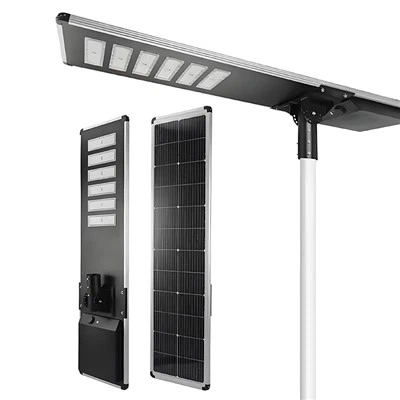
solar street lighting

Solar street lights are elevated light sources that are either positioned on the lighting structure or built into the pole itself and are powered by solar panels. A fluorescent or LED bulb is powered at night by a rechargeable battery that is charged by the solar panels.
The majority of solar panels operate automatically by detecting external light using a light source.
Solar lamps are designed to operate all night long. If the sun isn't out for a few days, many may remain illuminated for more than one night. Earlier versions had bulbs that weren't LED or fluorescent. In order to better withstand the winds, solar lights placed in windy areas often have flat panels.
Modern designs manage batteries using wireless technologies. Each street light equipped with this technology may function alone or as a network, depending on the situation.
Components
powered by the sun street lighting
There are 5 key components to solar street lights:
PV solar panel
One of the most crucial components of solar street lighting is the solar panel, which transforms solar energy into electricity. Both mono-crystalline and poly-crystalline solar panels are available. Mono-crystalline solar panels convert at a considerably greater rate than poly-crystalline ones.
Lighting Device
Modern solar street lights often employ LEDs as their illumination source since they produce significantly greater Lumens while using less energy. As compared to HPS fixtures, which are often utilized as illumination sources in traditional street lights, LED fixtures have an energy consumption that is at least 50% lower. As LEDs don't need any warm-up time, motion detectors may be used to increase efficiency even further.
Power Source: Rechargeable
The solar panel's electricity is captured by the battery during the day and used to power the fixture at night. The battery's life cycle and capacity have a significant impact on the lifespan and number of backup days of the light, respectively. Batteries typically come in two varieties: lead acid batteries and gel cell deep cycle batteries, among others.
Controller
For solar street light, controller is equally crucial. Lighting and charging are often switched on/off using a controller. Several contemporary controllers may be programmed, allowing the user to choose the ideal charging, lighting, and dimmer chance.
Pole
All street lights need sturdy poles, but solar street lights in particular require this since fixtures, panels, and sometimes batteries are often positioned on the pole's top. The PV panels and all electronics, however, are incorporated into the pole itself in some more recent versions. Furthermore a consideration is wind resistance.
Types
It is possible for each street light to have a separate photovoltaic panel from other street lights. Conversely, a number of panels may be set up as a central power source in a different place and provide electricity to several street lights.
Advantages
-Solar street lighting is not reliant on the power grid. The operating expenses are reduced as a result.
-Solar street lights need a great deal less upkeep than traditional street lights.
Accident risk is reduced as a result of the absence of external wires.
-This is an environmentally friendly source of power.
Individual solar system components may be transported to far-off places with ease.
Disadvantages
-Compared to traditional street lights, the initial investment is more.
On horizontal PV panels, snow or dust accumulation in the presence of moisture may lower or even halt energy generation.
-Over the course of the fixtures' lifetime, rechargeable batteries will need to be changed more than once, raising the cost of the light throughout its whole lifespan.